
AC Refrigerant Recharge and Leak Repair · St. Cloud, FL
AC Refrigerant Recharge and Leak Repair in St. Cloud FL: Find It, Fix It, Cool Again
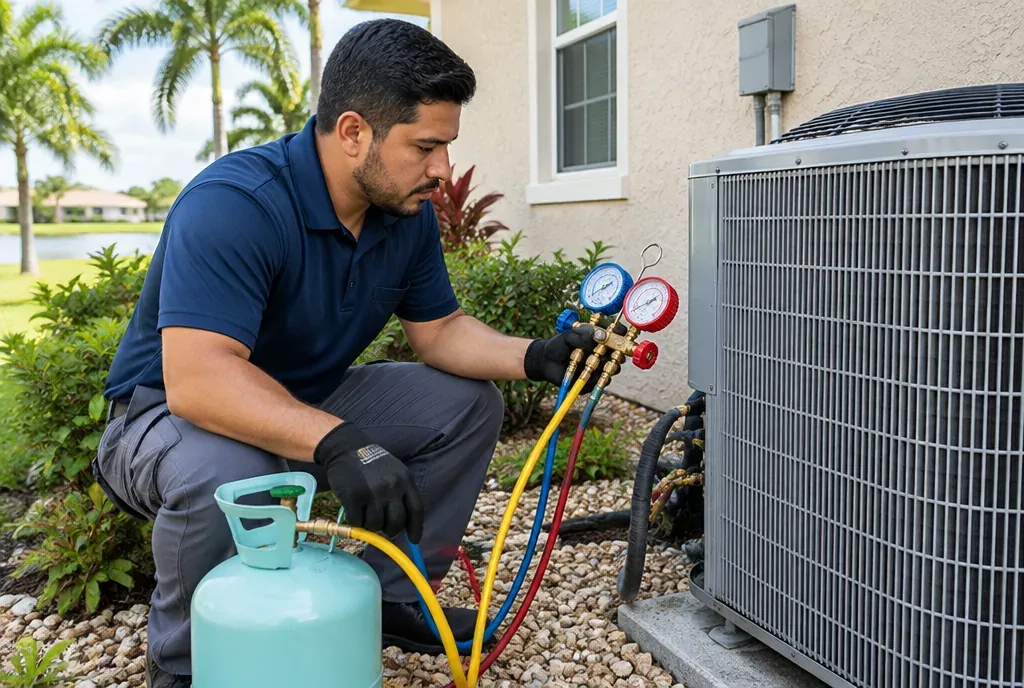
Low refrigerant means your AC can't cool properly. We recharge it to factory specs after checking for leaks. Call (407) 460-8406.
- Free estimates on every job
- 24/7 emergency service
- Satisfaction guaranteed
- Hablamos Español
Your AC is running but the air isn't cold enough. The house won't reach the set temperature. You might see ice forming on the indoor coil or the outdoor lines.
These are signs of low refrigerant. Baez & Son recharges AC systems across St. Cloud FL, and we always check for leaks first so you're not paying for refrigerant that's going to leak right back out.
If your AC runs but doesn't cool, or the indoor coil keeps freezing over, the most likely cause is a refrigerant leak. Simply adding more without fixing the leak wastes money and harms the environment. Baez & Son finds the leak, repairs it, and recharges your system to factory specs across St. Cloud FL.
When You Need a Refrigerant Recharge
It's likely low on refrigerant if:
- Your AC blows cool air but not cold enough
- Runs longer cycles
- Takes forever to cool the house
- Has ice forming on the coil or lines
Refrigerant doesn't get consumed like fuel. If it's low, there's a leak somewhere. A proper recharge requires finding and fixing any leak first, then adding the exact amount your system needs. Overcharging is just as bad as undercharging.
Warm air from your vents, ice forming on the indoor coil or refrigerant lines, hissing sounds near the outdoor unit, and an AC that runs constantly without reaching the set temperature are classic signs of low refrigerant. In Florida, the combination of heat cycling and vibration gradually weakens solder joints and connections over time. A slow leak can take months to become noticeable, but by the time you feel it, you've been overpaying on energy for a while.
5.0 · 42 Google reviews · Licensed CAC#1823925 | CMC#1251747 · Veteran-owned
Why Choose Baez & Son
We don't just top off and leave.
We find the leak, fix it, and recharge correctly. That's how it should be done.
Licensed, EPA-certified, veteran-owned, and we stand behind every service. We actually fix leaks.
Our technicians trace every leak to its source and repair it properly.
For all AC repair needs in the area, Baez & Son is your air conditioning repair.
Google reviews
What Customers Say
“Melvin was great. He answered my phone call after hours because of leaking AC unit. After giving me an estimated time, he was there right on time. Located the problem right away, and mentioned some things that need fixing in my AC unit. Also GREAT price. Definitely will use him from now on for any service in my home, and recommend him to anyone.”
“Exceptional service, professional, efficient, prepared and knowledgeable. Completely resolved an issue that other companies could not. Highly recommended. Melvin was great!”
“Melvin did an amazing job at servicing our AC unit in Saint Cloud Florida. He was super friendly, efficient and knew exactly what he was doing! I completely recommend this company for AC maintenance!!”
Our AC Refrigerant Recharge Process
We test your system's pressures and temperatures to confirm low refrigerant.
Then we check for leaks using electronic detectors and visual inspection.
After the system is sealed, we evacuate any moisture and contaminants, then recharge to the manufacturer's specifications.
We verify proper superheat and subcooling readings before we leave.
We test pressures and temperatures to confirm proper operation.
If we find a leak, we repair it first. Common leak points include evaporator coils, condenser coils, service valves, and solder joints on the line set.
5.0 · 42 Google reviews · Licensed CAC#1823925 | CMC#1251747 · Veteran-owned
AC Refrigerant Recharge Cost
Cost depends on your refrigerant type (R-410A, R-22, etc.) and the amount needed. R-22 is more expensive because it's being phased out. We quote the full price including leak check. Free estimates.
Cost depends on the leak location and how difficult it is to access. Coil leaks are more expensive than line connection leaks. If the coil is badly corroded and not worth repairing, we'll let you know. In cases where running low on refrigerant has damaged the compressor, our AC compressor replacement team handles that repair as well.
No surprises.
Current offer
Free, no-obligation estimates
You get a written estimate before any work starts. Repair visits carry a trip charge, credited toward the repair when you approve the work.
Request ServiceReplacing a system?
Pay over time with financing
We work with Lyon Financial so you can spread the cost of a new system. Approval and terms are set by the lender.
See financing optionsFrequently Asked Questions
How do you know if your home AC needs a refrigerant recharge?
The signs of low refrigerant in a home AC system are consistent and recognizable, though they develop gradually enough that many homeowners attribute them to other causes before a technician confirms the actual problem. The most common indicators are the system running longer than normal without reaching the thermostat setting, warm or only mildly cool air coming from the vents despite the system operating, ice forming on the refrigerant lines between the indoor and outdoor unit or on the evaporator coil, a noticeable decrease in cooling performance compared to the same time last year, and in some cases a hissing or bubbling sound near the refrigerant lines which indicates active leakage. For homeowners in St. Cloud and throughout Central Florida, a system that was cooling fine earlier in the season and has gradually gotten worse without any obvious cause is worth having a technician check refrigerant pressures before assuming the system needs a major repair.
The important context is that a home AC system does not consume refrigerant during normal operation. If the system is low, refrigerant has escaped through a leak somewhere in the circuit. A recharge without a leak diagnosis and repair is a temporary fix that will produce the same problem again within months, and a legitimate HVAC service call for low refrigerant always includes finding and addressing the source.
How much does a home AC refrigerant recharge cost?
Refrigerant recharge pricing in the St. Cloud and Central Florida market involves several components that vary depending on the refrigerant type, the amount needed, and whether the service call includes leak detection and repair. The refrigerant itself is priced by the pound. R-410A, which is the most common refrigerant in residential systems installed over the past decade, has seen pricing fluctuations as the industry transitions to newer refrigerants, and current market rates typically run between $50 and $100 per pound depending on supply conditions. Most residential systems hold between two and four pounds, so a full recharge on a depleted system can run $150 to $400 in refrigerant cost alone before labor and diagnostic fees are included.
A complete service call that includes leak detection, the repair, and the recharge typically runs between $300 and $700 in the St. Cloud and Osceola County market depending on the leak location and the extent of the work involved. For homeowners in Osceola County and the surrounding area, the most important cost consideration is that paying for a recharge without confirming and repairing the leak is paying to fill a system that will lose the refrigerant again. Baez & Son provides a written estimate that separates leak detection, repair, and recharge costs so you understand exactly what the service includes before authorizing any work.
Can a homeowner recharge their own home AC refrigerant?
No, and this is not a legal technicality that contractors cite to protect their business. Handling refrigerants in residential and commercial HVAC systems requires EPA Section 608 certification, and purchasing the refrigerants used in home AC systems, specifically R-410A and its successor refrigerants, requires that certification. Consumer refrigerant recharge kits sold at auto parts stores are designed for automotive systems and are not compatible with home HVAC equipment, which operates at significantly different pressures and uses different refrigerant types.
Beyond the legal and equipment compatibility issues, properly recharging a home AC system requires accurate pressure readings using calibrated manifold gauges to determine how much refrigerant the system needs, refrigerant recovery equipment to remove any remaining charge before a contaminated system is repaired, and the technical knowledge to confirm the system is operating within manufacturer specifications after the recharge. Overcharging a system, which is easy to do without proper gauges, causes compressor damage and can be more expensive to fix than the original low refrigerant condition. For homeowners in St. Cloud, Osceola County, and throughout Central Florida, the refrigerant recharge is one of the HVAC services where the gap between what a licensed technician does and what a homeowner can safely attempt is large enough that there is no practical alternative to calling a professional.
How long does a home AC refrigerant recharge last?
If the recharge is performed correctly and the leak that caused the low refrigerant condition has been located and repaired, the refrigerant charge should last the remaining service life of the system. Refrigerant does not evaporate, get consumed, or degrade during normal operation. A properly sealed AC system that was correctly charged at installation will hold that charge for 15 to 20 years without any top-off needed. The reason a recharge does not last for some homeowners is that the leak was not repaired before the system was recharged.
A system topped off with refrigerant while the leak remains active will lose the new charge through the same pathway, typically within one to three cooling seasons depending on the size of the leak. For homeowners in St. Cloud and throughout Central Florida who have had a system recharged in the past and are now experiencing the same symptoms again, that recurrence is a reliable indicator that the leak was not addressed the first time. A second recharge without leak repair is the same investment producing the same temporary result. Baez & Son does not recharge a system without completing a leak diagnosis first, and we do not complete the recharge without repairing the source, because a recharge that does not last is not a service that served the homeowner well.
Can a refrigerant leak in a home AC system actually be repaired?
Yes, in most cases a refrigerant leak can be repaired rather than requiring a full system replacement, and repair is the right path when the leak is localized, accessible, and the rest of the system is in reasonable condition. The most common refrigerant leak locations in residential AC systems are the evaporator coil, the service valves on the outdoor unit, the refrigerant line set connections, and the Schrader valve ports. Pinhole leaks in evaporator coils caused by formicary corrosion are the most frequently diagnosed leak type in Central Florida homes, and depending on the severity and location of the corrosion, the coil can sometimes be repaired though replacement is often the more durable solution.
Line set connection leaks and service valve leaks are generally straightforward repairs that restore the system to full integrity once addressed. For homeowners in St. Cloud, Osceola County, and the surrounding service area, the decision framework is similar to other major AC repairs: the age of the system, the location and extent of the leak, and the cost of the repair relative to the remaining useful life of the equipment all factor into whether repair or replacement is the better path. Baez & Son provides a written assessment of both options after completing the leak detection so you have the information needed to make an informed decision before authorizing any work.
Where do refrigerant leaks most commonly occur in a Central Florida AC system?
The evaporator coil is by far the most common site of refrigerant leaks in residential AC systems in the St. Cloud area and throughout Central Florida, and Florida's specific environmental conditions are a significant reason why. Evaporator coils in Florida homes are exposed to consistently high humidity and volatile organic compounds from household products and building materials, which combine to cause formicary corrosion, a type of pitting corrosion that attacks copper tubing at a microscopic level and eventually creates pinhole leaks. This process happens faster in Florida than in most other climates because the evaporator coil is wet almost continuously during the long cooling season. The service valves on the outdoor condenser unit are the second most common leak location, particularly on older systems where the valve cores have degraded or were not properly torqued during a previous service visit.
Line set connections at the indoor and outdoor unit are also frequent leak points, particularly in systems where vibration has loosened flare fittings over time. For homeowners in Osceola County, Polk County, and the surrounding service area, a refrigerant leak that is found and repaired at the evaporator coil connection or service valve is a straightforward fix. A coil with widespread formicary corrosion that has developed multiple pinhole leaks across the coil surface is a different situation that often makes coil replacement the more cost-effective long-term solution.
Is it safe to stay in a house with a refrigerant leak?
In most residential scenarios, a refrigerant leak does not create an immediate safety emergency that requires you to leave the home, but it is not a situation to leave unaddressed for an extended period either. The refrigerants used in modern residential AC systems, primarily R-410A and its successor refrigerants, are not acutely toxic at the low concentrations that result from a typical residential leak. However, in a confined space with a large leak or a severely compromised system, refrigerant can displace oxygen and cause symptoms including dizziness, headaches, and nausea. A strong chemical or sweet smell near the indoor unit, which some homeowners describe as a solvent or acetone odor, is a signal that the leak rate is significant enough to warrant keeping windows open and calling for service the same day rather than waiting.
For homeowners in St. Cloud and throughout Central Florida, the more immediate practical concern with a refrigerant leak is system damage rather than health risk. A system operating with a low refrigerant charge runs the compressor outside its design pressure range, which accelerates wear and can lead to compressor failure if the condition continues. Getting a licensed technician on-site to locate and repair the leak protects both the equipment and the household.
How do technicians find refrigerant leaks in an AC system?
Finding a refrigerant leak in a residential AC system requires more than a visual inspection because refrigerant is colorless and odorless at low concentrations and the leak points are often inside the air handler cabinet or within coil assemblies that are not easily visible. Licensed HVAC technicians use several methods depending on the suspected leak location and severity. Electronic leak detectors are the most commonly used tool for general leak detection. The technician moves a probe along the refrigerant circuit components, and the detector signals when refrigerant vapor concentration rises above a threshold.
UV dye detection is another approach where a fluorescent dye is injected into the refrigerant circuit and the technician uses a UV light to find the leak point, which shows as a glowing trace at the source. Nitrogen pressure testing, where the refrigerant is recovered and the system is pressurized with dry nitrogen, is the most definitive method and is particularly useful for finding slow leaks that electronic detectors may not register consistently. For homeowners in St. Cloud, Kissimmee, and throughout Osceola County, the method a technician uses matters less than whether they actually confirm and document the leak location before authorizing the recharge. A recharge without a confirmed and repaired leak source is an incomplete service, and a reputable HVAC contractor will not perform one without identifying where the refrigerant was going.
5.0 · 42 Google reviews · Licensed CAC#1823925 | CMC#1251747 · Veteran-owned
AC Not Cold Enough? Call Now
AC refrigerant recharge across St. Cloud. Call (407) 460-8406. Same-day service.