
AC Repair · St. Cloud, FL
AC Repair in St. Cloud FL: Fast Cooling Restored, Any Brand
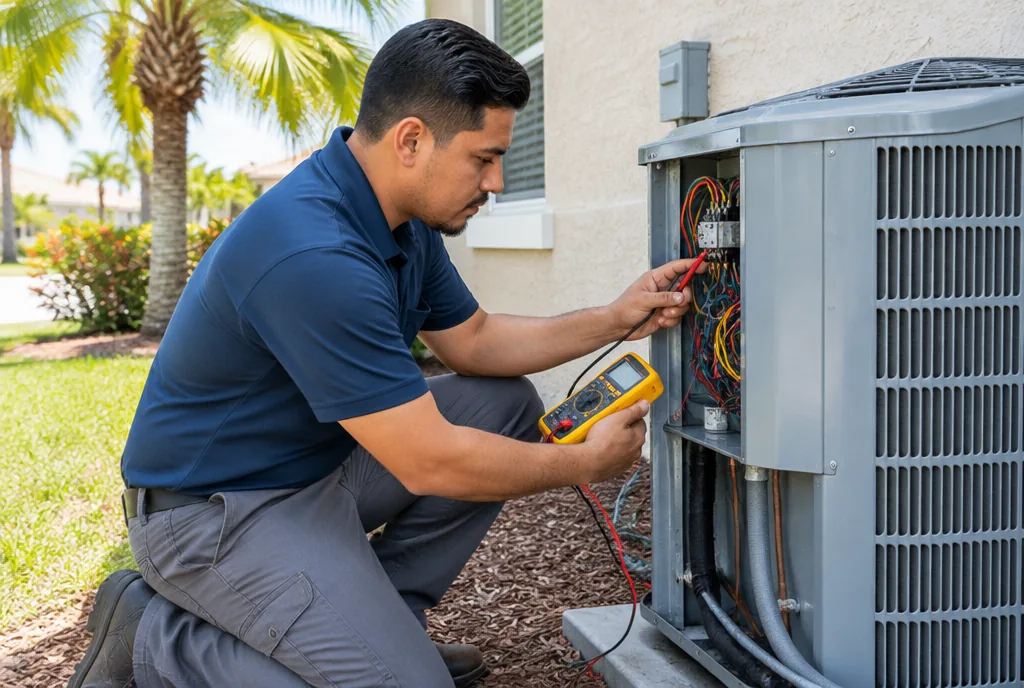
Your AC stopped working and your house is getting hotter by the minute. Baez & Son repairs all brands with same-day service. Call (407) 460-8406.
- Free estimates on every job
- 24/7 emergency service
- Satisfaction guaranteed
- Hablamos Español
The air coming out of your vents is warm, the thermostat says it's running, and the temperature keeps climbing. Or maybe the system won't turn on at all. Whatever your AC is doing wrong, Baez & Son fixes it. We repair every major brand and system type across St. Cloud FL with a 45-minute average response time.
Central air conditioning systems have multiple components that have to work together: the compressor, condenser, evaporator coil, blower motor, thermostat, and ductwork. When any one of them fails, the whole system suffers. Baez & Son specializes in central AC diagnostics and repair across St. Cloud FL. We find the real problem, not just the symptom.
When You Need AC Repair
Call for AC repair when your system:
- Blows warm air
- Cycles on and off without cooling
- Makes grinding or buzzing sounds
- Leaks water around the indoor unit
- Won't turn on
If your energy bill spiked and nothing else changed, your system may be running inefficiently due to a failing component. In Central Florida, the combination of heat, humidity, and year-round usage wears parts faster than homeowners expect. Waiting turns small repairs into big ones. If your system is completely down, our emergency AC repair team responds fast.
Warm air from your vents, rooms that won't cool evenly, ice on your indoor coil, a system that short-cycles, or a unit that runs but never reaches the thermostat temperature. All are signs of a central AC issue. Many of these problems are caused by refrigerant leaks, failing capacitors, or dirty coils. In Florida's climate, contaminant buildup happens faster than in cooler regions, and electrical components take more heat stress.
5.0 · 42 Google reviews · Licensed CAC#1823925 | CMC#1251747 · Veteran-owned
Why Choose Baez & Son
45-minute average response.
Licensed (CAC#1823925, CMC#1251747), insured, and veteran-owned.
We stand behind every repair and fix it right the first time.
We work on central AC systems every day.
Our technicians know the specific failure patterns in Central Florida.
For full-service air conditioning repair in the area, Baez & Son is your air conditioning repair service.
Google reviews
What Customers Say
“Melvin was great. He answered my phone call after hours because of leaking AC unit. After giving me an estimated time, he was there right on time. Located the problem right away, and mentioned some things that need fixing in my AC unit. Also GREAT price. Definitely will use him from now on for any service in my home, and recommend him to anyone.”
“Exceptional service, professional, efficient, prepared and knowledgeable. Completely resolved an issue that other companies could not. Highly recommended. Melvin was great!”
“Melvin did an amazing job at servicing our AC unit in Saint Cloud Florida. He was super friendly, efficient and knew exactly what he was doing! I completely recommend this company for AC maintenance!!”
Our AC Repair Process
We arrive, diagnose the problem, and give you a written estimate before starting any work.
We test your system from the thermostat to the outdoor unit.
We check refrigerant levels, electrical components, airflow, and temperature differentials between supply and return air. This tells us exactly what's failing and why.
Our trucks carry the most common parts: capacitors, contactors, fan motors, and refrigerant, so most repairs are completed the same visit.
We test the system after the repair to make sure it's cooling properly and running at the right temperatures.
If a part needs to be ordered, we'll tell you the timeline upfront. If the condenser specifically is the problem, our condenser repair team handles those repairs in depth.
5.0 · 42 Google reviews · Licensed CAC#1823925 | CMC#1251747 · Veteran-owned
AC Repair Cost in Central Florida
Repair cost depends on what's wrong. A capacitor replacement is the low end. Compressor or coil replacements are on the higher end. We give you the exact price before doing any work.
You're never locked in. If you don't approve the estimate, you owe nothing.
Simple electrical fixes cost less than refrigerant leak repairs or coil replacements.
No hidden charges.
Current offer
Free, no-obligation estimates
You get a written estimate before any work starts. Repair visits carry a trip charge, credited toward the repair when you approve the work.
Request ServiceReplacing a system?
Pay over time with financing
We work with Lyon Financial so you can spread the cost of a new system. Approval and terms are set by the lender.
See financing optionsFrequently Asked Questions
Why is my AC running but not cooling the house?
This is one of the most common calls Baez & Son receives across St. Cloud and Central Florida during the summer months, and the cause is almost never what homeowners expect. When the AC is running but the house is not cooling, the system is operating but failing to transfer heat effectively, and there are a handful of specific reasons that happens. A refrigerant leak is the most frequent culprit. As refrigerant levels drop, the system loses the capacity to absorb heat from the indoor air and reject it outside, so it runs continuously without making meaningful progress on the temperature.
A dirty evaporator coil is the second most common cause, because a coil caked with dust and biological buildup cannot absorb heat efficiently even with adequate refrigerant. A failing compressor that is running but not producing sufficient pressure is a more serious finding that often points toward a repair versus replace conversation. For homeowners in Osceola County, Polk County, and the surrounding service area, a frozen evaporator coil is also worth checking, which presents as the system running without cooling because the ice buildup is blocking airflow entirely.
The right response is not to keep waiting and hoping the situation resolves. A system running continuously without cooling is accumulating wear and driving up the electric bill at the same time. Baez & Son provides same-day diagnostic service across St. Cloud so you know the actual cause before you decide what to do next.
Should you turn off your AC if it stops blowing cold air?
Yes, and the sooner the better. Running an AC system that is not cooling is not a neutral situation. Depending on what is causing the failure, continuing to run the system can compound the problem and turn a repair into a more expensive one.
If the evaporator coil has frozen over, continuing to run the system pushes more air across a blocked coil, which does nothing to cool the house and can eventually back up refrigerant pressure and stress the compressor. If the system is low on refrigerant due to a leak, running it in that condition forces the compressor to operate outside its normal pressure range, which accelerates wear. The right sequence is to switch the thermostat to the fan-only setting or shut the system off entirely, then call a licensed HVAC technician for a same-day diagnostic.
Switching to fan-only rather than fully off allows the frozen coil to thaw more quickly if ice is present, which makes the diagnostic visit more productive. For homeowners in St. Cloud, Kissimmee, and throughout Osceola County, the concern about shutting off the AC in a Florida summer is understandable, but a system that is running without cooling is not providing comfort anyway and is running up the utility bill in the process. Getting a technician on-site quickly is the faster path back to a working system than hoping the problem resolves on its own.
What is the $5,000 rule for AC repair, and how does it apply in Central Florida?
The $5,000 rule is a widely used guideline for evaluating whether to repair or replace an AC system. The rule works by multiplying the age of the unit in years by the cost of the repair in dollars. If the result exceeds $5,000, replacement is generally the more financially sound choice. If it comes in below $5,000, repair is typically the better path.
A ten-year-old system facing an $800 repair produces a product of $8,000, which by this rule points toward replacement. The same $800 repair on a four-year-old system produces $3,200, which clearly points toward repair. For homeowners in St. Cloud and throughout Osceola, Polk, and Orange Counties, the rule is a useful starting framework but should not be applied without also considering a few Florida-specific factors. A system approaching the refrigerant transition away from R-410A may face parts availability challenges that make repairs more expensive over time regardless of age.
A system that has had multiple component failures in a short window is showing signs of general decline that the rule alone does not capture. And a system that is undersized for the home or was never correctly installed may warrant replacement on those grounds independent of the repair cost calculation. Baez & Son walks through this analysis on every repair call where the age and cost of the work make it relevant, so you are making the decision based on real numbers and honest guidance rather than a sales pitch for either outcome.
Do home AC units have a reset button, and will resetting fix the problem?
Most central AC systems do not have a single accessible reset button the way a smaller appliance might, but there are reset sequences that homeowners can try before calling a technician, and in specific situations they do resolve the issue. The outdoor condenser unit on many systems has a reset button, typically a small red button located on or near the refrigerant lines on the unit itself, that trips as an overload protection mechanism when the system overheats or experiences a power surge. Pressing this button after the unit has had time to cool down, usually 30 minutes, can restore operation if the overload was caused by a temporary condition rather than an underlying failure.
The circuit breaker at the electrical panel is the other reset point, and a tripped breaker is worth checking and resetting once before calling for service. What a reset does not fix is any actual component failure. A capacitor that has failed, a refrigerant leak, a frozen coil, or a compressor with failing bearings will not be resolved by a reset, and in some cases cycling power to a failing component repeatedly can accelerate the damage.
For homeowners in St. Cloud and throughout Central Florida, the practical guidance is to try the reset once if the system has tripped off without an obvious cause, give it 30 minutes before restarting, and call Baez & Son for a diagnostic if the system trips off again or still does not cool after restarting. One unexplained shutoff that resolves on its own is worth monitoring. Two in a row is a signal that something needs professional attention.
What are the most common problems with central air conditioners in Florida homes?
Central AC systems in St. Cloud and throughout Central Florida develop a predictable set of problems that repeat consistently across service calls, and understanding them helps homeowners recognize what they are dealing with before a technician arrives. Capacitor failure is the single most common repair call in this market. Capacitors are small electrical components that help start and run the compressor and fan motors, and Florida's heat degrades them faster than in most other climates. A system that hums when trying to start, starts briefly and then shuts off, or fails to start the outdoor unit at all is often pointing to a capacitor.
Refrigerant leaks are the second most common issue, producing symptoms like the system running continuously without reaching the set temperature, ice forming on the refrigerant lines, or a noticeable decline in cooling capacity over time. Contactor failure, dirty evaporator or condenser coils, clogged condensate drain lines, and blower motor failures round out the most frequently diagnosed problems. For homeowners in Osceola County, Polk County, and the surrounding service area, most of these failures share a common thread: they develop gradually and become more expensive to address the longer they are ignored. A capacitor that is reading low on a test but has not failed yet costs far less to replace proactively than the compressor damage that can result from running a system with a marginal capacitor through a Florida summer.
What is the most expensive component to replace in a central AC system?
The compressor is consistently the most expensive single component in a central AC system, and for homeowners in St. Cloud and throughout Central Florida a compressor replacement is the repair that most often leads to a conversation about whether full system replacement makes more sense. Depending on the unit size, refrigerant type, and brand, a compressor replacement typically runs between $1,200 and $2,800 installed on a residential system. On systems that are ten years or older, the installed cost of a compressor replacement frequently approaches or exceeds the 50 percent threshold that the $5,000 rule uses to point toward replacement rather than repair.
The evaporator coil is the second most expensive repair, typically running between $800 and $1,500 installed, and is a repair that also warrants a careful age and condition assessment before committing. For homeowners in Osceola County, the important context around both repairs is that Florida systems accumulate significantly more runtime per year than systems in northern climates, which means the remaining useful life calculation after a major repair on an older system is a shorter runway than the same calculation would be in a less demanding climate. Baez & Son provides a straight written assessment of repair versus replace on every call where the cost and age of the system make that conversation relevant.
What is the average lifespan of a central AC unit in Florida, and what affects it?
Most residential central AC units are rated for a lifespan of 15 to 20 years, but for homeowners in St. Cloud and throughout Central Florida the realistic expectation is 12 to 16 years for a system that receives regular maintenance, and potentially less for one that has been neglected. The Florida climate shortens HVAC lifespan primarily through accumulated runtime. A central AC system in Osceola County runs for roughly eight to ten months of active cooling per year, compared to four to six months in most northern states. That additional runtime puts more hours on the compressor, more thermal cycling stress on electrical components, and more biological activity in the drain system and on the evaporator coil.
The gap between a well-maintained system and a neglected one is typically three to five years of additional service life, which at current replacement costs represents a meaningful return on the investment in annual tune-ups. For homeowners in Polk County, Orange County, and the surrounding service area whose systems are approaching the 10 to 12 year mark, the right move is to schedule a condition assessment rather than wait for a failure. Understanding the current state of the compressor, coils, and electrical components gives you the information needed to plan a replacement on your timeline rather than reacting to an emergency in the middle of July.
What is the 3-minute rule for central AC, and should homeowners follow it?
The 3-minute rule is a widely repeated guideline that advises waiting at least three minutes after shutting off a central AC system before restarting it. The reason behind it is legitimate. Central AC compressors operate under refrigerant pressure, and when the system shuts off, that pressure needs time to equalize across the high and low sides of the refrigerant circuit before the compressor attempts to start again.
Restarting the system immediately before pressure equalizes forces the compressor to start against an unbalanced load, which puts mechanical stress on the motor windings and can, over time or in a single event on a weakened compressor, cause damage. Modern systems often include a built-in time delay relay that enforces this automatically, but older systems and systems where the delay relay has failed do not have that protection. For homeowners in St. Cloud and throughout Central Florida, the practical application is straightforward.
If the power goes out and comes back, or if you adjust the thermostat and hear the system start and stop several times in quick succession, giving the system a few minutes before the next start cycle is a reasonable habit that costs nothing and reduces wear. It is not a repair for any actual problem the system has, and following it will not fix a system that is already malfunctioning. If the system is short-cycling repeatedly on its own without manual intervention, that is a symptom of an underlying issue that needs a diagnostic from a licensed technician, not a timer.
5.0 · 42 Google reviews · Licensed CAC#1823925 | CMC#1251747 · Veteran-owned
AC Down? We're On the Way
Same-day AC repair across St. Cloud and Central Florida. Call (407) 460-8406. No obligation.